
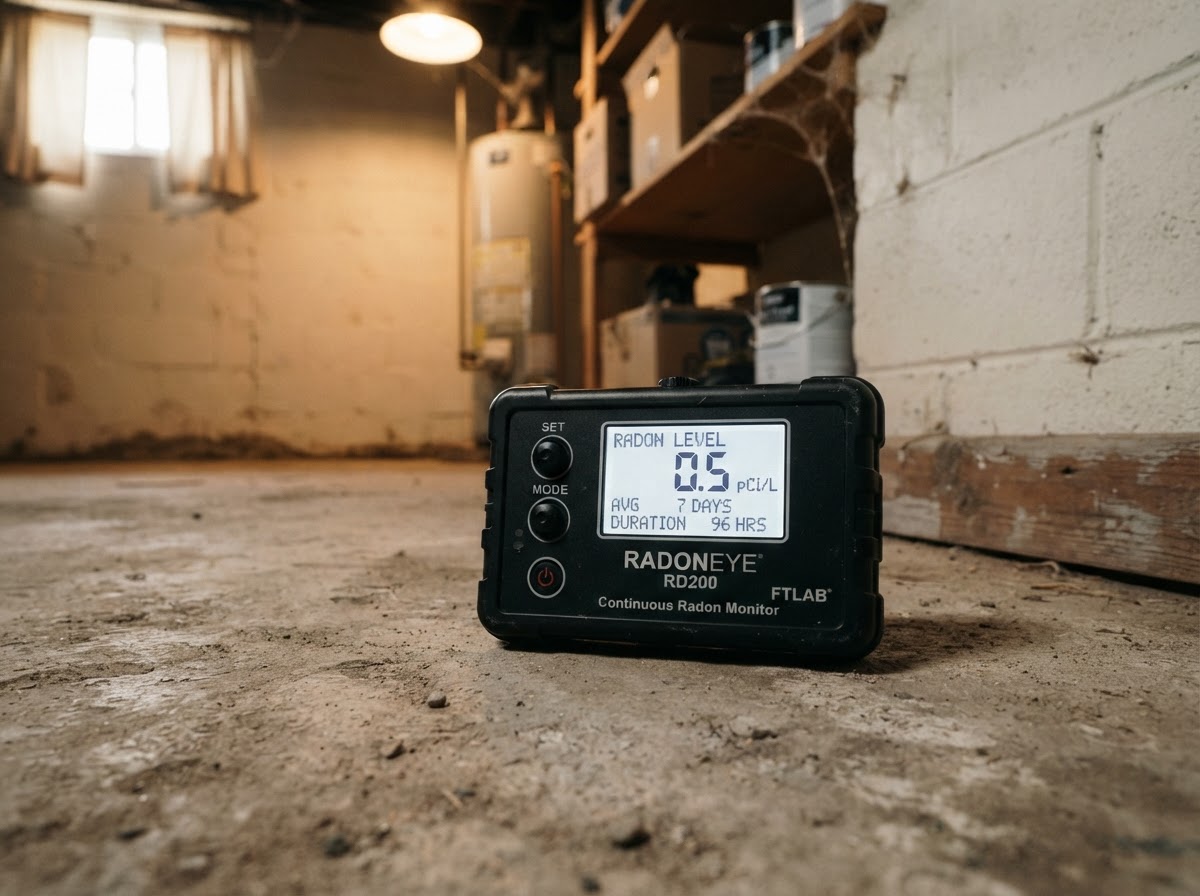
You Can't See Radon.
Test It.
Radon can't be evaluated by looking at the property. Testing gives you property-specific information instead of relying on assumptions about the house, its age, or the surrounding area.
Owner-operated. Work directly with Inspector Lott.
A Question Appearance Can't Answer
A Beautiful House Can Still Leave This Question Unanswered.
Radon is a naturally occurring radioactive gas that can enter buildings from the ground.
It is colorless, odorless, and tasteless.
That means the way a property looks does not tell you its indoor radon level.
A renovated basement does not answer the question. Neither does the age of the house or how well maintained it appears.
If you want property-specific information, you test the property.
Property-Specific Evidence
The House Next Door Can't Give You This Property's Answer.
Radon levels can vary from one building to another.
The general radon risk of an area may provide useful background information, but it does not tell you the exact indoor level at a specific property.
The property itself needs to be tested if you want information about that property.
This is the heart of the Inspector Lott approach:
Do not substitute an assumption for a measurement when the answer can be tested.
When to Consider Testing
Sometimes the Reason to Test Is Simply That You Don't Know.
Testing provides property-specific information in situations where relying on assumptions leaves questions unanswered.
Buying a Home
You want property-specific radon information before making a major property decision.
Selling a Home
You want to better understand the property's current radon level before or during the selling process.
A Property That Has Not Been Tested
You do not have reliable current information about the indoor radon level.
After Mitigation
Testing can be used to confirm the radon level after corrective work has been performed.
After Major Renovation or Weatherization
Changes to a building may be a reason to consider testing again.
Lower-Level or Ground-Contact Space
You want information about the radon level in a property where lower-level space is used or occupied.
From Question to Answer
Measure the Level. Then Decide What It Means for the Property.
Test
Measure the indoor radon level.
Understand
Review the result and understand what the measurement tells you about the property.
Address If Needed
If the result indicates that action should be considered, consult the appropriate qualified professional regarding mitigation.
Retest
After mitigation or other corrective action, testing can help confirm the resulting radon level.
The Result Is Information
A Higher Result Gives You Something Useful: An Answer.
An elevated radon result does not automatically tell you to abandon the property.
It tells you that the condition deserves attention.
Radon levels can often be reduced through appropriate mitigation.
The next step is to understand the result, determine what action may be appropriate, and confirm the outcome with follow-up testing when necessary.
The first step is knowing the number.
Inspection vs. Testing
Radon Requires a Measurement, Not a Visual Check.
A standard home inspection is primarily a visual evaluation of accessible conditions.
Radon is different. Because it cannot be seen, smelled, or tasted, its indoor level requires measurement.
That is why Inspector Lott offers Radon Gas Testing as its own service.
If you're also purchasing a home, the two services can answer different questions about the same property.
Buying a Home?
Know What You're Buying Before It Becomes Yours.
Combine visual evaluation with property-specific testing so you have clearer information before making a major decision.
Evidence Over Assumption
When You Want to Know, Test the Property.
Inspector Lott's approach is straightforward:
When something can be observed, inspect it.
When the answer requires measurement, test it.
The goal is to give you clearer property-specific information so you can decide what comes next with your eyes open.
Common Radon Questions
Common Questions About Radon Testing.
Don't Assume. Test.
Get a Property-Specific Answer.
If you want to know the radon level at the property, start by telling Sam what you need and where the property is located.